 by Fr. Thomas Hopko –
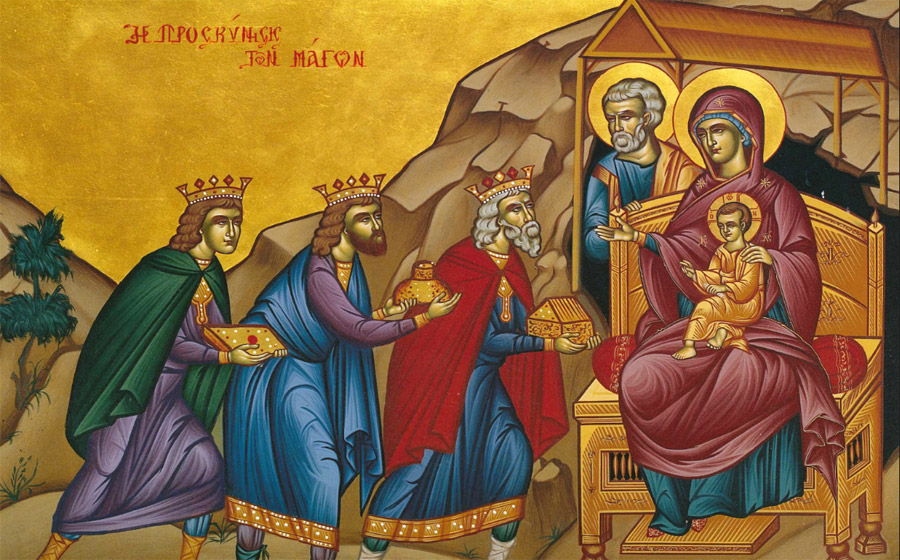
The adoration of Jesus by the wise men from the East is part of the Nativity celebration in the Orthodox Church. The spiritual and theological significance of the coming of the kings with their gifts is of paramount importance.
The coming of the wise men bears witness to the fact that Jesus has come as King and Lord for all people, and not only the Jews. In the persons of the Persian kings the Church sees all the peoples of the earth and all the kingdoms of men. For, as the main hymn of the feast proclaims, “those who worshipped the stars were taught by a star” to adore Jesus as Lord.
The hymns of our Church sing:
The Magi, kings of Persia,
Knew that You, the Heavenly King,
Were truly born on earth.
They came to Bethlehem
Led by the light of a star,
And offered their chosen gifts:
Gold, frankincense, and myrrh.
Falling before You they worshipped,
For they saw You who are timeless
Lying as a babe in the cave.
The gifts of the Magi are of particular significance. They are interpreted symbolically in the liturgy of the feast.
The gift of gold is taken as the sign that Jesus is the king of Israel, of the entire universe, and of the kingdom of God to come. This is a crucial part of the Christmas story in the gospels. It caused Herod to kill all the “male children in Bethlehem and in all the region who were two years old or under, according to the time which he had ascertained from the wise men” (Mt 2:16).
The gift of frankincense is taken by the liturgy to signify the fact that Jesus is God, since incense is for worship, and only God may be worshipped.
And the gift of myrrh is for the Lord Jesus who has come to die as the perfect sacrifice for the people. For the dead were anointed with myrrh, as Jesus Himself was anointed according to the Scriptures, at the time of His death (Jn 19:39-40).
In the gifts of the Magi, therefore, are contained all the mysteries of Christ’s coming. They point to the purpose of His appearance on earth. He is the royal king, the Son of David, whose kingdom will have no end. He is the victim, the Lamb of God, who by His death takes away the sins of the world.
And He is God Himself, the divine Son of the Father: “Light of Light, true God of true God; begotten, not made; of one essence with the Father, by whom all things were made; who for us men and for our salvation came down from heaven. . .” as the Nicene Creed declares. The contemplation of the wise men and their gifts is an integral and lasting part of the Church’s celebration of the Lord’s Winter Pascha.
—————————————————
Excerpts from the book The Winter Pascha by Fr. Thomas Hopko. (Minor organizational edits to optimize readability and emphasize key points made by Chris Banescu.)